There's a pain every revenue team knows: the account you wanted badly, worked hard to get a meeting, and eventually gave up on.
One of our customers had a dream account like that - a company they'd wanted for years, tried pursuing and got nowhere.
And then, ten days after our FDE rebuilt their pre-pipeline set up HiveLoop - sharper message, grounded in what that buyer role cared about - they got a response and that too from the COO. That's what happens when someone is close enough to your business to know what good looks like.
When we were building Hivekind, we made a deliberate decision: before we scaled sales, we'd hire people whose job was to make customers successful. Managing accounts or handling tickets matter, but we needed someone to own outcomes.
We call them Forward Deployed Engineers (FDEs). The title matters, and it's worth explaining what it means.
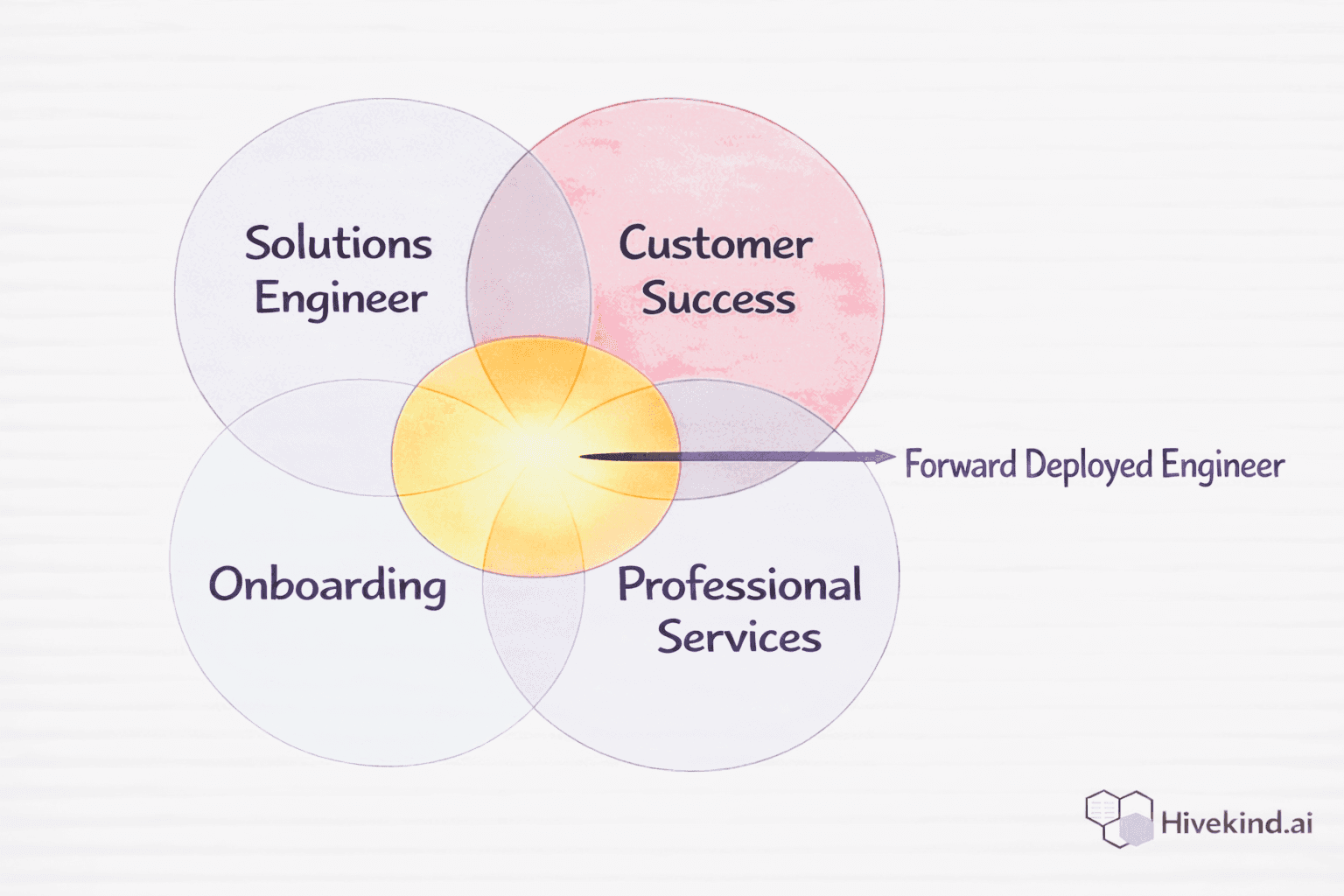
Most software companies split customer-facing into roles such as solutions architects that handle pre-sales, they design the approach and close the technical gap during the deal. Customer Success handles post-sales - they run QBRs, get renewals, and escalate support tickets. Professional services handles implementation - they set it up and hand it back.
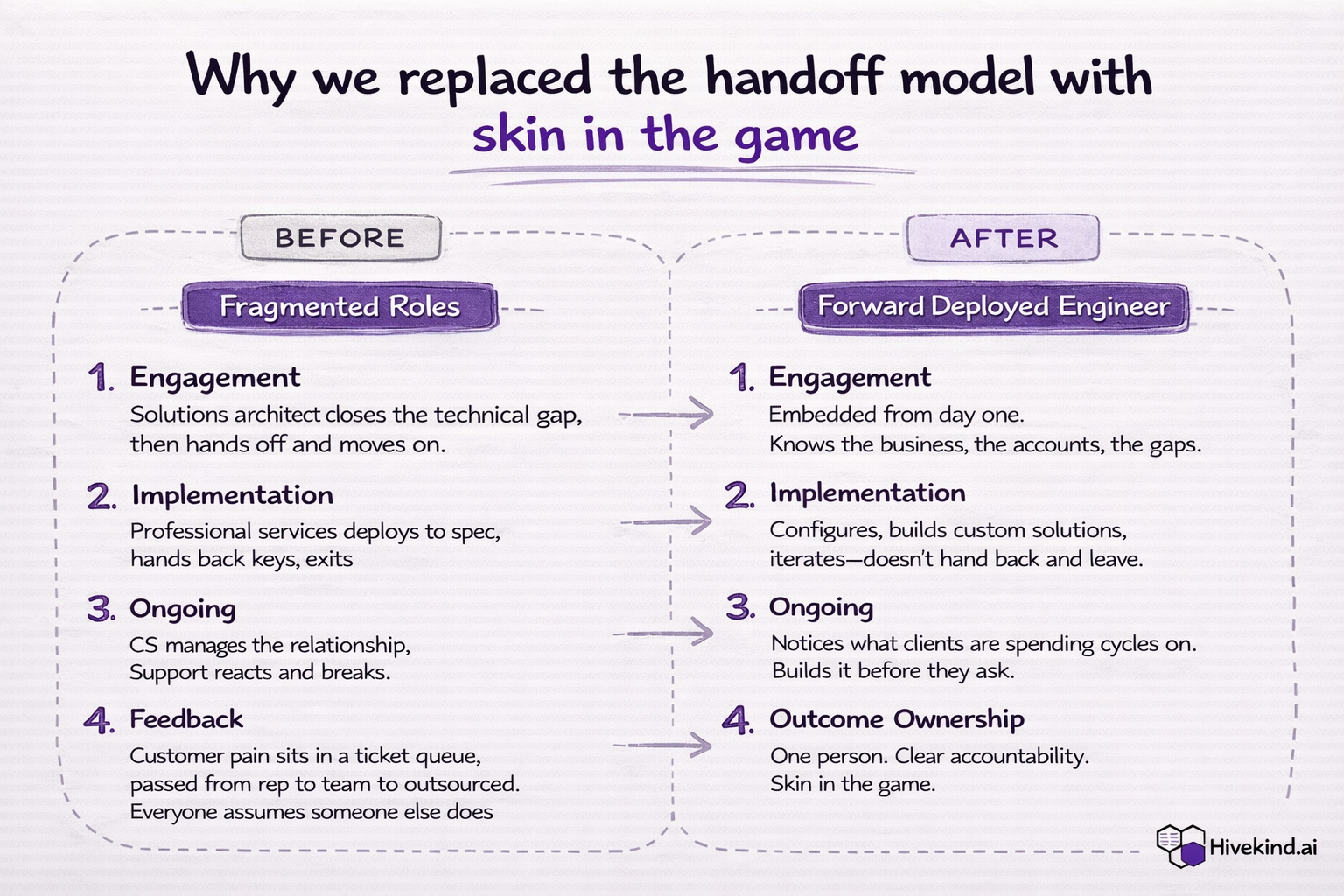
An FDE sits at the intersection of all of them, plus product engineering. They can configure the system, write custom solutions, diagnose what isn't working, and bring what they've built back into the product. They're technically deep enough to build, and functionally sound to understand what a customer is actually trying to achieve.
In an AI product context, this matters more than people realize. AI systems get tuned, iterated, and shaped by real-world usage. FDEs bridge the gap between what a model or agent can do in theory and what it does for a specific customer's workflow, in real time, without having to wait for the next release.
What does that look like for GTM teams?
An FDE doesn’t wait to be told what’s broken. They see a client spending cycles on battlecard creation and build a prototype before anyone filed a request. They recognize personalized landing pages for outbound campaigns will double the impact and build it. Whitepaper structures, new outreach angles, use cases the customer hadn't considered — these come from someone who is paying close enough attention to see them.
This also accelerates something that most software companies are slow at: the feedback loop. When an FDE encounters a real limitation at a customer site, it doesn't take three product cycles to address. They bring it back directly and what works for one customer shapes what gets prioritized in the product roadmap. Customers stop waiting quarters for a roadmap item and start seeing their real problems become product features.
Our customers are often impressed by the quality of outbound the system generates. But they're more surprised when an FDE shows up with something they didn't ask for — a personalized landing page, a new use case, a lead magnet that speaks to their champion persona, but nobody had thought about.
The result is that adoption happens faster, and it goes deeper because someone was present enough to remove the friction.
We believe in skin in the game.
That phrase gets used loosely, but we mean it. It matters because outcome-based models are becoming the expectation in B2B and the impact of AI is still largely unproven - buyers want proof before they commit, and we think they’re right to want that. But outcome-based only means something if someone actually owns the outcome.
The FDE is that person - the human who sits close enough to the customer's reality to know when something isn't working, why, and what to do about it.
That's why we built this role before we scaled anything else.