Why context signals need to drive actions (and visibility alone is not enough)
In The Rime of the Ancient Mariner, Coleridge describes a strange kind of abundance - water everywhere but not a drop to drink. An old idea, but the irony is true in modern life too.
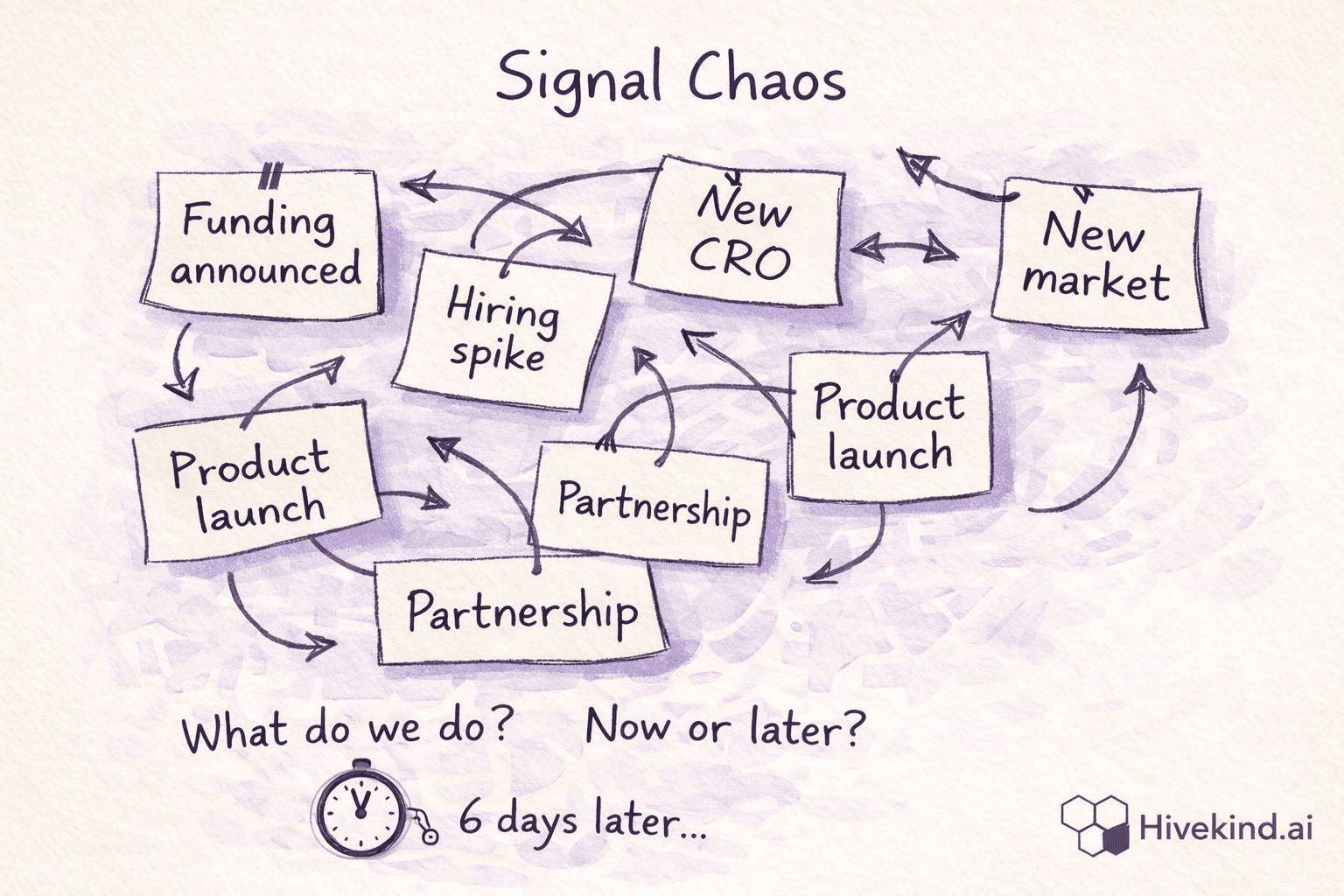
In B2B go-to-market, we have no shortage of signals - funding announcements, leadership changes, hiring spikes, new product launches, partnerships and so on. In theory, these moments can be life-giving for your pipeline. But we know it doesn’t become so.
Every tool surfaces them and while teams see them, not much changes. Is it a problem of lack of resources? No. If anything, they have too many. The issue is a delay in acting on signals because the burden of interpreting them falls entirely on reps.
Take something simple. A company raises funding and it’s on a dashboard, or in CRM or Slack, maybe in a weekly report. Eventually someone notices it, then they have to decide what it means, whether it matters, which rep owns the account and how they should act on it. By the time that chain of thinking completes, the moment that made the signal valuable has already passed.
The use of context signals in prospecting is no longer timely. Even when signals are seen quickly, they come with an unspoken expectation: someone has to figure them out. A rep looks at a hiring trend or a leadership change and has to answer a set of questions on the fly. Is this relevant to us? Should I act now or wait? What do I say differently because of this?
None of these are trivial decisions. And they sit on top of hundreds of accounts, dozens of signals, and a finite amount of time and attention.
So in practice, most signals are ignored - they still hold value, but they are expensive to think about. Teams fall back to the easy: pre-built sequences, routine activity for the static list of accounts. Signals get reduced to a line of personalization, if at all.
We’ve ended up in a strange place where there is no shortage of signals, coverage has improved, speed of catching them has improved, but usefulness hasn’t. Because usefulness is in knowing how to act on signals, not adding more sources.
We refer to these as context signals - tangible changes inside an account that alter the timing or relevance of your outreach. Unlike intent signals, which infer interest and are noisy, context signals reflect something that has tangibly changed. These are not about guessing or probabilities.
How signals can create pipeline
Signals, on their own, do not create pipeline. Decisions do, and those decisions require clarity on two things: whether to act at all, and how the approach should change in response to what just happened. Sadly, neither of these happens consistently right now.
Today, these decisions are fragmented, with some tools trying to score and prioritize while others help with personalization. But no system consistently carries a signal all the way through - from detection to a clear, timely decision and execution that changes how an account is worked. Miss that connection and signals are isolated from action.
Get the connection right, and a signal stops being an alert but becomes the reason. The reason an account is actively worked right now and not next week. The reason the message says something different. The reason other stakeholders in the account are engaged. The reason a rep walks into a conversation knowing exactly why now. Execution adjusts based on the decisions behind it.
This is also why pipeline rarely breaks at the point of execution. By the time a sequence runs, most of the outcome has already been shaped by earlier choices: which accounts were selected, when they were engaged, and what context informed the outreach. If those decisions are off, better copy or more activity doesn’t fix it.
The more useful way to think about signals is not as alerts, or triggers, but as inputs into a decision system that continuously answers: which accounts should we work now, and why?
That system doesn't exist in most GTM stacks today. Intent data gives you probabilities. Dashboards give you visibility. CRM gives you a point-in-time snapshot. None of them give you a decision.
We've spent years getting better at seeing signals. The next problem is acting on them — consistently, at the right moment, without the burden falling on a rep to figure it out on the fly. Until signals are connected to decisions and action, they remain incomplete. And incomplete signals, no matter how abundant, don’t create pipeline.