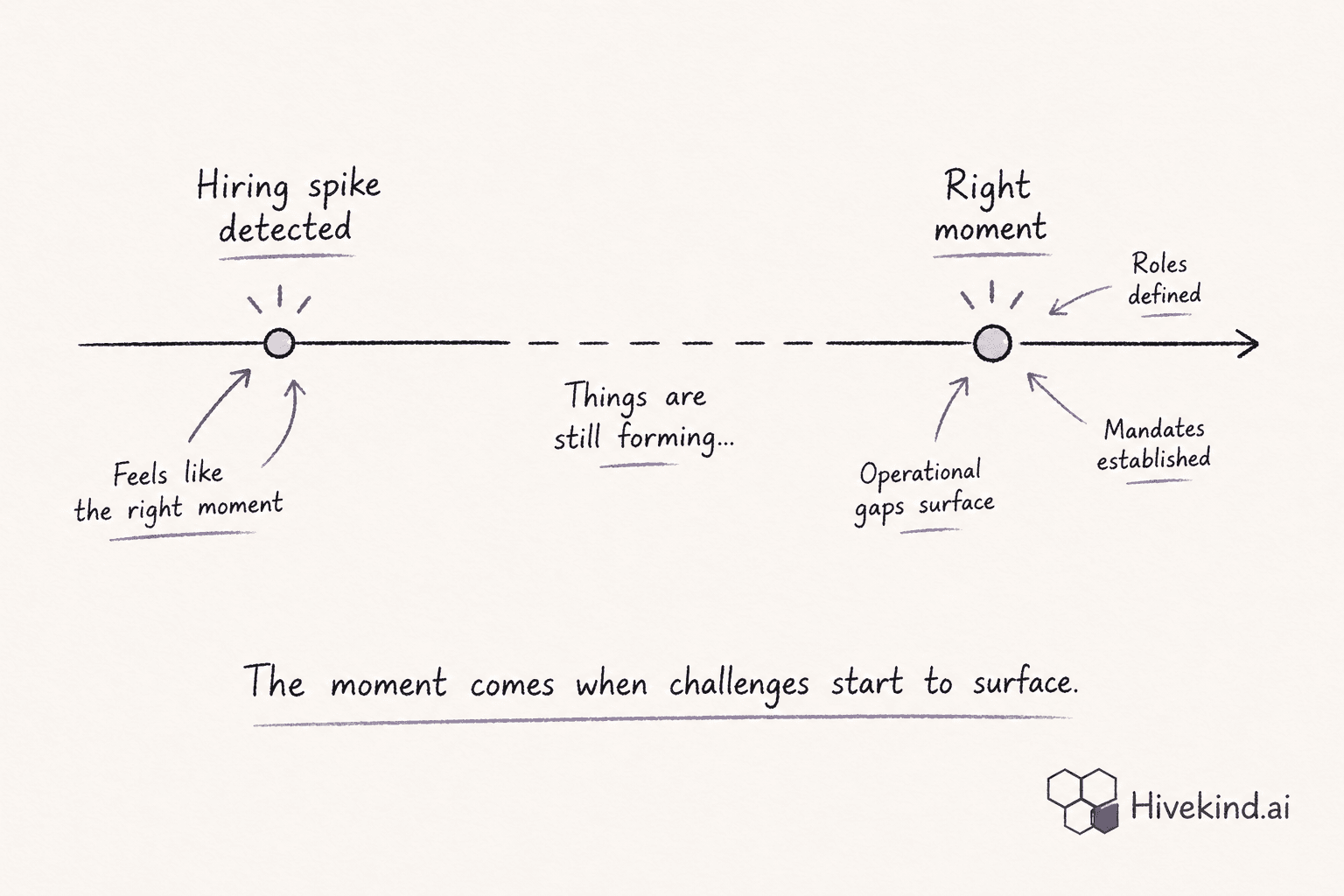
A hiring spike in B2B looks like the perfect moment to reach out, but in reality it’s when attention is lowest and noise is highest. Treat hiring as a trigger instead of an evolving signal, and you’re reacting too early. The real opportunity comes when patterns stabilize and operational challenges associated with hiring start to surface. The teams that win are the ones that time it right, and that’s not necessarily being the fastest to act.
What is a hiring signal in B2B sales?
A hiring signal is an indicator that a company is expanding, restructuring, or investing in new capabilities. It reflects internal change but does not necessarily mean the company is ready to buy.
A sudden spike in hiring is one of those signals that feels too good to ignore. New positions are announced, headcount expands, and from the outside it looks like a company is gearing up for growth. For most GTM teams, that’s a green light, with more budget and momentum. Surely, this is the moment to reach out.
But that’s exactly where things could go wrong.
Because the moment a hiring spike becomes visible externally is the same moment it gets noisy internally. Recruiters are flooded, and hiring managers are stretched. The organization is trying to absorb change, not invite new vendors, so while the need might exist, attention is scarce.
This is the detail that needs thinking. As a vendor, you may treat hiring spikes as immediate triggers, when in reality they are early signals that are not yet actionable.
What follows is a predictable pattern. In the first couple of weeks, job postings go live and outbound teams rush in with variations of the same message: “Saw you’re hiring…” It’s well-intentioned, but indistinguishable. Your message lands amongst one of dozens, maybe hundreds. It doesn’t matter how personalized it is at the surface level. It’s arriving at the wrong moment.
A few weeks in, hiring is still in motion, and internally things are unsettled. Roles are being defined, expectations are shifting, and teams are still figuring out what this growth actually means for how they operate. Reaching out right after hiring tends to underperform unless you are already known or saying something genuinely different.
When does a hiring spike become actionable?
The real opportunity emerges later, once the hiring motion starts to stabilize. Patterns begin to form: roles cluster around specific functions. This is the point where growth starts creating pressure inside the system. More devs mean more code gets shipped, but not necessarily stronger system reliability. A growing team of IT architects often signals complexity. Rapid expansion in technical capacity tends to expose gaps in security and integration.
This is when your message has a chance to land - because it aligns with a problem the buyer is beginning to feel, not just a signal you happened to detect.
Most teams react to the first visible sign of hiring, rather than tracking how that signal evolves. A couple of job postings are treated the same as sustained growth across a function. Observation is mistaken for insight, and timing is reduced to speed of reaction.
A more effective approach is slower, but far more precise. Instead of reacting to isolated job postings, you wait for confirmation. You look for meaningful growth - say, a 10 to 30 percent increase in a specific function, or multiple roles opening within the same team over a few weeks. You give the signal time to mature and act with context.
That shift changes the entire tone of your message. The company already knows they’re hiring - you need to connect that hiring motion to the operational challenges that tend to follow. The conversation then needs to be about “Here’s what usually breaks at this stage.”
It’s a small difference on the surface, but it fundamentally changes how you’re perceived. One is reactive. The other is informed.
Operationally, this also requires a different way of thinking about signals. Detection alone isn’t enough - you need thresholds that separate noise from true signal, and calculated delays that ensure you’re not acting too early. A hiring spike becomes meaningful when it crosses a certain level of growth, persists over time, and concentrates in a function relevant to your offering. From there, timing matters just as much as the signal itself. Acting immediately is rarely the right move, waiting a couple of weeks often is.
What you’re really doing is shifting from a binary view of signals (present vs not present), to a more dynamic one. Signals have a lifecycle, and the value lies in understanding where you are within that lifecycle before you decide to act, to be truly effective.
A hiring spike, on its own, is the start of a clock, and not a cue to start prospecting on its own. Act too early, and you disappear into noise. Wait until the signal matures, and you show up when the underlying problem is starting to feel real.
The answer then is not to optimize for speed, but for the right timing.
Quick Answers
Should you reach out when a hiring spike is detected?
Not immediately. A hiring spike signals internal change, but not readiness to engage. Reaching out too early often results in low relevance and poor response.
Why isn’t a hiring spike the right time to act?
Because the team is still forming, priorities are shifting, and the problem isn’t fully defined yet. Reaching out at this stage feels premature.
How long after a hiring signal should you wait?
When the hiring translates into visible change: new roles onboarded, responsibilities defined, or operational pressure increasing.
What does a hiring spike actually indicate?
It indicates growth, restructuring, or new initiatives. It’s a leading signal of change, not a sales trigger for immediate outreach.
How should sales teams use hiring signals?
To monitor accounts, prepare context, and identify the right moment; rather than triggering immediate campaigns.
What matters more than the hiring signal for sales?
What happens after it. The signal only becomes valuable when it leads to a change in priorities, structure, or urgency within the account.