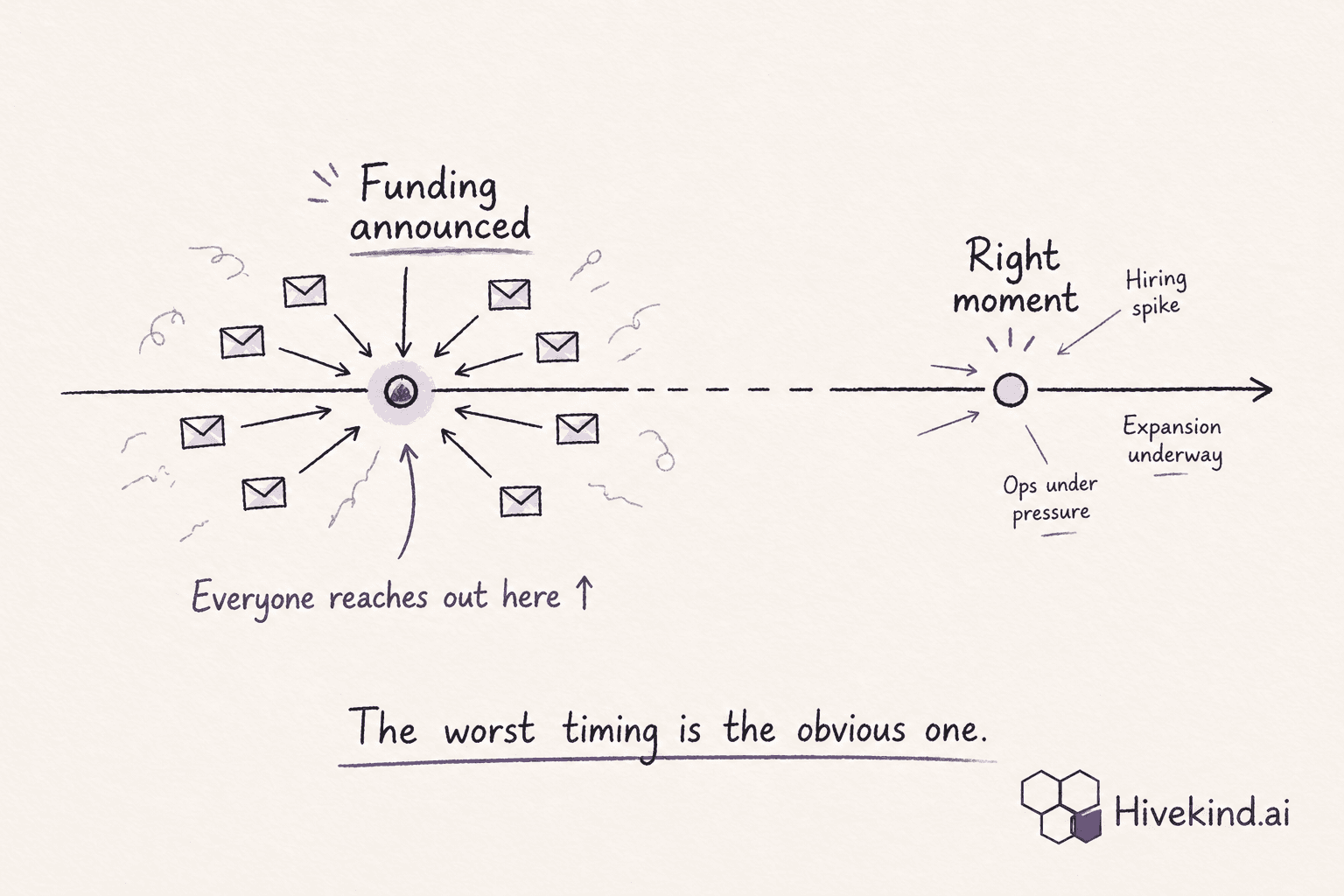
A funding announcement looks like the perfect moment to reach out, but it’s when noise is highest and attention is lowest. Most teams act instantly, treating funding as a trigger instead of a start of a journey. The real opportunity comes when capital starts turning into hiring, expansion, tooling decisions, and operational pressure. Timing your outreach around those downstream signals, not the announcement itself, is what makes it land.
Quick Answers
Q. When is the worst time to reach out after funding?
A. Immediately after the announcement, when inbound noise is highest and attention is lowest.
Q. When should you actually reach out?
A. A few weeks later, once funding starts translating into hiring, expansion, tooling or system changes.
Q. Why doesn’t outreach work right after funding?
A. Because priorities are still undefined, and every vendor is reaching out at the same time.
Q. Is funding a good buying signal?
A. Yes, but only after it matures into observable changes within the organization.
Q. What is a funding signal?
A. A funding signal indicates that a company has raised capital and is likely entering a phase of growth and change. However, it is an early-stage signal—useful for context, but not immediately actionable.
A fresh funding round feels like the clearest buying signal you can get. A company just raised capital, made headlines, and from the outside it looks like everything is in place: budget, high ambitions, and change is on the horizon. For most GTM teams, if there was ever a time to reach out, this must be it.
Through several conversations with people at the receiving end, we know that it rarely is. Because the moment a funding round is announced publicly is when noise spikes and founders get inundated. Executives are pulled in every direction - every vendor, recruiter, and partner is clamoring for attention, often with the same message in slightly different words.
It looks like peak opportunity, but those on the inside know it's when they are still figuring things out.
This is where most teams misuse the signal, treating funding as a trigger, when it is actually the start of a transition. Capital has been raised, but very little of it has been deployed. Priorities and plans are still being decided and the organization is not yet in a position to evaluate new tools or partners in any meaningful way.
Why does outreach fail after funding?
Because the signal is visible before it is actionable and noise is at its peak, much before priorities are defined.
So the first wave of outreach fails, predictably. Messages that begin with “Congrats on the funding” are a dime-a-dozen, and easy to ignore. No matter how relevant the pitch is, it’s competing against too many similar attempts, at a time when attention is scarce.
The Signal Maturity Curve
1. Detection → Funding is announced
2. Noise Spike → Everyone reaches out
3. Maturity → Hiring, expansion, and decisions begin
4. Action Window → The right time to engage
Funding is most visible in Stage 1 but is most actionable in Stage 4.
A few weeks later, the noise begins to settle, and the company starts translating capital into decisions - hiring plans, execution of strategic priorities, expansion efforts, investments in tooling and infrastructure. It is still early, and most of the real problems have yet to surface. More engineers mean faster product development, but also greater strain on testing and coordination. Expansion into new markets introduces complexity in systems and processes. Increased investment in growth often exposes gaps in integration, visibility, or control across the stack.
Now is when your outreach has valid context. It is no longer anchored to the fact that funding happened, but to what that funding is causing.
Most teams react to the funding announcement as a single moment, rather than a sequence. A more effective approach is far more deliberate. Instead of acting on the announcement, you wait for downstream signals that indicate how the capital is being used. You look for patterns - sustained hiring in a function, signs of expansion, changes in systems. Once the signal matures, you then engage when the implications are clearer.
This changes the nature of the conversation - you no longer reference the funding which is stale information the moment it becomes public. Instead, you are speaking to the challenges that tend to emerge once growth is underway. The message becomes “Here’s what typically breaks”
This separates noise from relevance.
Operationally, this requires treating funding as the beginning of a timeline. Detection is easy, and what matters is what happens after. The signal is meaningful when it leads to measurable change - when hiring accelerates, when teams expand, when systems are stretched. Outreach timing then needs to be a function of those changes.
In practice, this often means waiting a few weeks before acting. Long enough for patterns to emerge and for your outreach to land at a time where it can actually be considered.
A funding announcement is not a green light, it’s the start of a clock. Act too early, and you are just part of the noise. Act when the signal matures, and you show up when the organization is ready to engage.
Q. When should you act on a funding signal?
A. You should act when hiring increases in specific functions, expansion or new initiatives become visible, operational pressure surfaces. You should not act when the funding is freshly announced, there are no downstream signals visible and the priorities are still unclear
Q. How to apply this in practice?
A. Don’t trigger outreach on funding announcements. Track how capital is deployed over time, and look for secondary signals (hiring, expansion, tooling). Time outreach based on emerging challenges