We've spent the last few months talking to B2B revenue teams and founders about how they decide which accounts to pursue. The teams we talk to don't think their execution is the problem. They have sequences, they have outreach tools, they have a CRM they're familiar with.
What are they missing? Clarity on who is the right fit, and whether now is the right moment to act. And there are no easy answers there; it's something one has to discover over time, often through trial and error, and rigorous testing. A good starting point is avoiding the temptation of believing "everyone can use this." It's understandable, not wanting to limit your target market, but narrowing is how one develops clarity of positioning.
This is a layer we think is worth investing in, and it's forced us to hold a clear distinction we think is right.
The question behind every ICP score
If we ask a GTM team "is this account a good fit," the answer usually has two parts.
First is about identity: does this company look like the accounts we win.
The second is about timing: is something happening at this company right now that suggests they're ready to buy.
Plenty of scoring systems and intelligence platforms blend these into a single number, or simply look past the fit question. They assume fit is given - a founder knows their ICP anyway, and now needs data on buying activity and intent signals.
A signal fires, say, a new VP hire, and it gets folded into a score, answering ‘why this account, and why now’. Timing creates urgency, but it doesn't create fit and it shouldn't overshadow the base criterion that's supposed to represent the fundamental account fit. Should one activity nudge an account's score upward, irrespective of whether that account was a match for your segment to begin with? Over time, the score is no longer an indicator of fit, and instead becomes representative of recent events.
We think this is worth naming precisely, because conflating the two can skew the baseline.
The shoe doesn't stop fitting because the clock struck midnight. And a fit score shouldn't move with an account's day-to-day activity.
So do we ignore signals?
No.
Instead, we build ICP scoring logic with two basic pillars, and signals are kept separate on purpose.
First pillar is public evidence, i.e., what's externally observable about a company: industry, business model, size, geography, technology in use, team and business maturity, and other market attributes one could gather from the outside. This layer also carries the hard disqualifiers — the traits that rule an account out regardless of anything else about it.
Second is internal evidence, which comes from a business's own CRM, connected via HubSpot or Salesforce through MCP. This includes prior opportunities, closed-won and closed-lost history, existing customer status, known contacts, past engagement, and how closely an account resembles the accounts that have converted before. This is the layer that makes a score specific to a company's own history, adding relevance to firmographics.
Signals are layered on top, and they’re deliberately pulled out of the score itself. Signals answer a timing question, not a fit question, so they act as a boost applied on top of an established score - instead of an input that recalculates the fundamentals. And like any timing signal, they're perishable: a boost from a job change six months ago won’t carry the same weight as one from last fortnight.
The premise, plainly: ICP score means an account is fundamentally a good match for you. Signals mean something is happening right now. We don’t conflate the two.
A fair question here is whether fundamentals should ever change at all. They should. Deliberately, against real closed-won and closed-lost outcomes, not in reaction to weekly activity. The distinction is that fundamentals aren’t frozen forever. They move when you decide to revisit them, when the market has shifted, and the nature of deals you’re winning has changed. They don’t change because an account happened to be in the news.
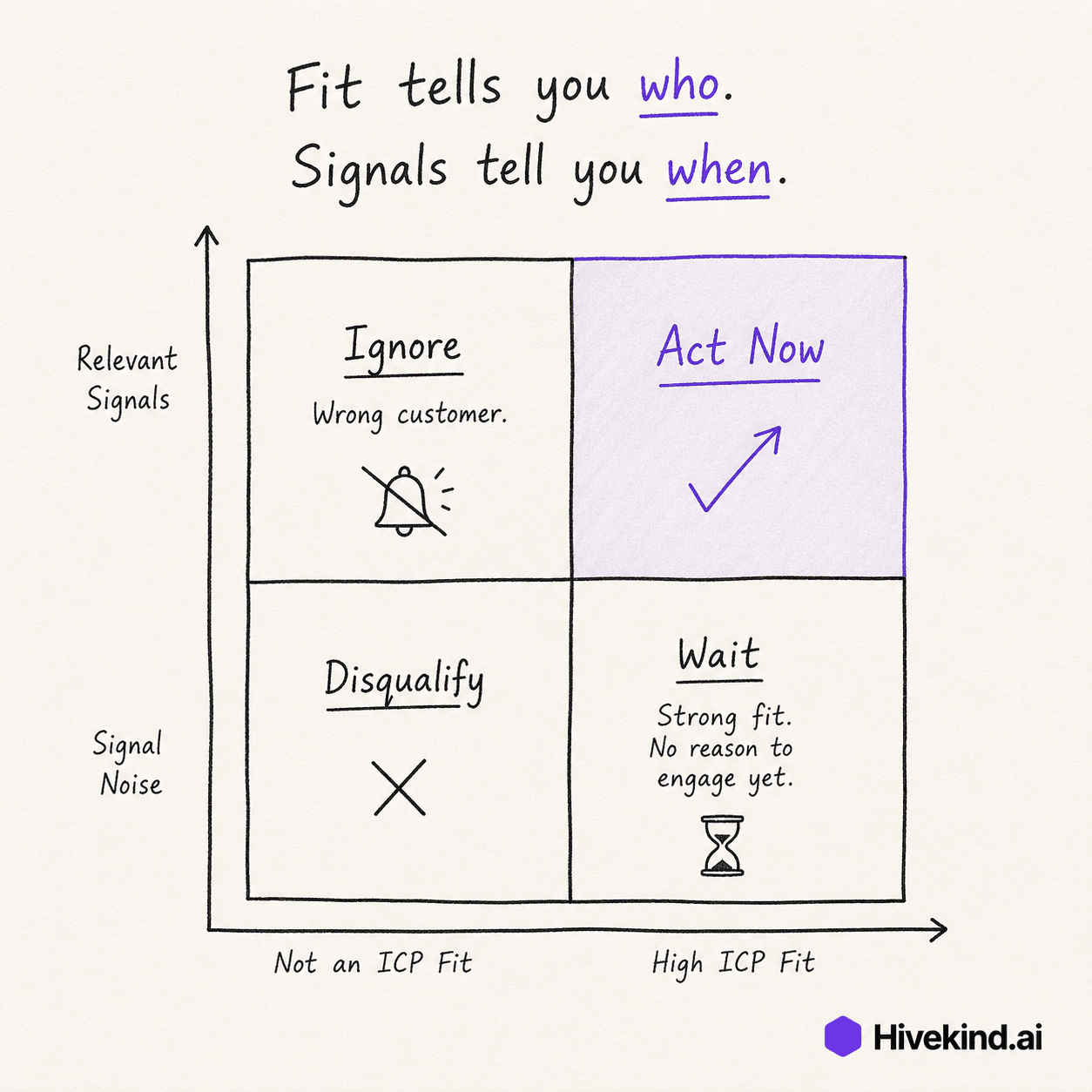
Let’s put fit and signal relevance on two axes, and the decision becomes clear, not limited to a single number. A strong fit with no signal isn't a dead end, it tells you to wait. A weak fit with a loud signal is worth discarding anyway - not doing something is strategy as well. The one quadrant worth acting on immediately is where both are true at once.
When the Bottleneck Is Not Execution, But Decisions
None of this is about better outreach. If anything, the market is telling us outreach isn't where teams can differentiate. Sending emails, running sequences, managing a cadence - those are solved problems, and most teams have tools they're happy with.
What's missing is the decision underneath: who deserves that outreach, and when. That's a genuinely hard problem, and it's one worth spending effort on. Integrations into the tools teams already use for execution are the bridge.
Fit tells you who. Signals tell you when. The promise of the right score is getting that distinction right, and not letting signals hijack the fundamentals.
FAQs
What's the difference between an ICP fit score and a buying signal?
An ICP fit score measures whether an account structurally matches your ideal customer profile — industry, size, region, and CRM history. A buying signal indicates timing: something happening right now that suggests an account may be ready to engage. Fit answers who; signals answer when.
If signals don't affect ICP, how do you prioritize?
We think of prioritization as two layers: Priority = Fit × Timing. A great-fit account with no buying activity stays monitored. A poor-fit account with strong buying signals still isn't worth pursuing. The best opportunities are where strong fit and strong timing intersect.
Why shouldn't CRM engagement data change an account's fit score?
Letting recent activity adjust a fit score creates a circular feedback loop: engagement makes an account look like a better fit, which drives more engagement, regardless of whether the account ever matched the segment. Fundamentals should be revisited deliberately against closed-won and closed-lost outcomes, not reactively.
Do buying signals lose value over time?
Yes. Signals are perishable. For instance, a hiring change or intent spike from several months ago carries less weight than one from the past week. Signal-based scoring should account for recency, not treat all signals as equally current.
How is this different from intent-data platforms like 6sense?
Many intent platforms lead with in-market and buying-stage signals, treating ICP fit as an assumed input rather than something the platform actively defines and protects. This approach keeps fit and timing as two independent measures, using signals only as a boost on an established score — never as an input that redefines fit.
What should a company do with a strong-fit account that has no active signal?
Wait, rather than disengage. A strong fit with no current signal simply means it isn't the moment to act yet. Do not deprioritize it in favor of a weaker-fit account with a loud signal - that's chasing noise instead of the right account.