Picture this: Everyone has worked through their disagreements and aligned on the GTM strategy during the offsite, complete with the ICP definition. Your PMM then spent three weeks refining your messaging framework and sharpening competitive positioning using market inputs from the last six months. The buyer personas finally capture how your best customers behave.
It was all built deliberately. People signed off on it.
But what next? Did strategy continue to drive decisions after everyone got back to office?
The Isolation Problem
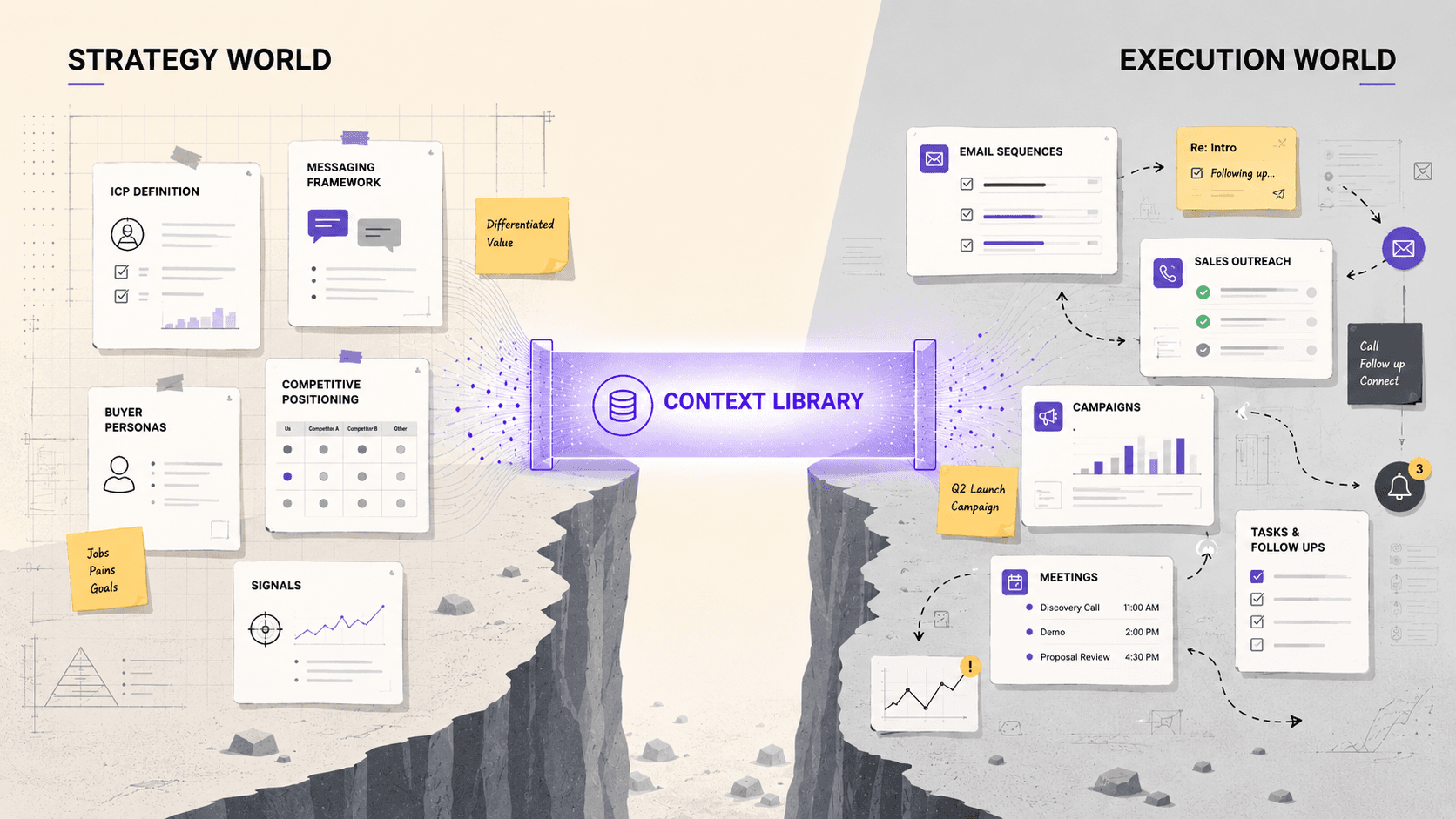
If your GTM teams operate with a strategy layer and an execution layer that rarely connect, you’re not alone. The strategy layer is in documents - positioning decks, ICP definitions, persona frameworks, competitive battlecards. The execution layer lives in tools - sequences, campaigns, signal dashboards, enrichment workflows.
Between them is a gap - we call this missing connection the Context Layer.
The result is predictable. Outreach doesn't reflect current positioning and messaging. Campaigns are built on random ICP assumptions. Signals fire but you don’t know which ones actually matter for your specific buyer. Messaging is generic because it is written without reference to what’s going on in the account.
The gap is a structural one because there is no persistent layer that carries strategy into execution, so execution defaults to whatever a given rep remembers, or whatever the last update to a sequence said.
GTM runs on knowledge that lives in people's heads, while the documents that were deliberately created are ignored.
What Changes when Strategy is Connected
When the system knows your positioning and your buyer personas, it generates messaging that reflects how your company actually talks about its value. It adapts the angle, the proof point, the hook for the CFO, vs the VP of Sales, because it understands what each role cares about.
When the system knows your ICP definition - which is not just the firmographic filters but the operational context, the jobs to be done, the scoring criteria, it stops treating all matching accounts equally. It grades them continuously against the criteria your team has agreed on.
When the system knows your competitive context, it adjusts its pitch to differentiate from others.
This is the difference between execution that draws on your strategy and execution that ignores it. The output looks completely different, making your strategy the infrastructure.
Introducing the Context Library
The Context Library is the persistent intelligence layer inside Hivekind that connects your GTM strategy to every decision the system makes.
It stores the building blocks your team has already built:
Positioning & Messaging: how you talk about your value, in the language your buyers actually use
Ideal Customer Profiles: not just firmographic filters, but the operational context and scoring criteria that distinguish accounts with genuine fit from accounts that only meet the basic criteria
Buyer Personas & Motivations: the roles involved in complex deals, what they care about, what they're trying to achieve, what they're worried about
Context Signals: the signal types that matter for your specific ICP, filtered from the noise
Competitors: the landscape your buyers are navigating, and how your positioning holds up against it
Offers & Value Hooks: what you're leading with, for which accounts, at which stage
Proof Points: the outcomes, case studies, and references that make claims credible
Once these are in place, every touchpoint, every signal interpretation, every buying group message draws from them. No more starting from a blank page, it’s about leveraging the thinking that already exists inside your business.
Strategy as Infrastructure
Our recent ICP blog posed a question “Does your ICP live in a Notion doc, or does it actually inform your team's workflow?”
The Context Library is the answer to that question: for ICP, and for every other strategic asset your GTM team has built. To be clear, it doesn't replace the strategic work but makes the strategic work count across every account, every signal, every message the system produces.
Because the gap between strategy and execution is a failure of connection - and that's a solvable problem.
Context Library is available now as part of the Hivekind Pre-Pipeline System. Book a demo to see it in action
FAQs
Q: What is a GTM Context Library?
A: A GTM Context Library is a centralized layer that stores strategic assets such as ICP definitions, buyer personas, messaging frameworks, competitive positioning, and proof points, making them available to guide execution across campaigns and outreach.
Q: Why do GTM strategies fail in execution?
A: GTM strategies often fail because the strategic decisions made during planning are not connected to the systems and workflows used by teams every day. As a result, execution defaults to individual judgment rather than agreed principles.
Q: What types of information belong in the Context Library?
A: Context Library can include: Product offerings, ICP definitions and scoring criteria, Buyer personas and motivations, Messaging frameworks, Competitive positioning, Signal definitions, Offers and value propositions, Proof points and customer outcomes
Q: How is Context Library different from a knowledge base?
A: A knowledge base stores information for reference, but doesn’t necessarily drive decisions. Context Library operationalizes that information by allowing systems and teams to use it in decision-making and execution.