The Math of Demand Creation: Why Capture Fails at 6-6-6
I keep running into founders and CROs who "believe in demand creation" the way people believe in eating better. Nice idea. Doesn't survive contact with a quota.
So let me make the argument a different way. Not as philosophy, as math.
Run it. $5M in new ARR at a $100K average deal size is 50 wins. The plan assumes a 33% win rate, so the model asks for 150 qualified opportunities. We land at 20%. Those same 50 wins now require 250. A 13-point miss doesn’t cost you 13% of anything — it costs 100 additional opportunities, and roughly $10M in incremental pipeline once you carry it at coverage. Worse, it lands in the QBR as a demand gen problem when nothing about demand gen changed.
Then it compounds. When you’re bidding on a spec someone else wrote, you don’t hold price either. Concede 12% and effective deal size falls to $88K — so 50 wins becomes 57, and 250 opportunities becomes 284. The plan asked for 150. Nobody missed by a little. The origination gap nearly doubled the number, and every quarter the answer is “more top of funnel.”
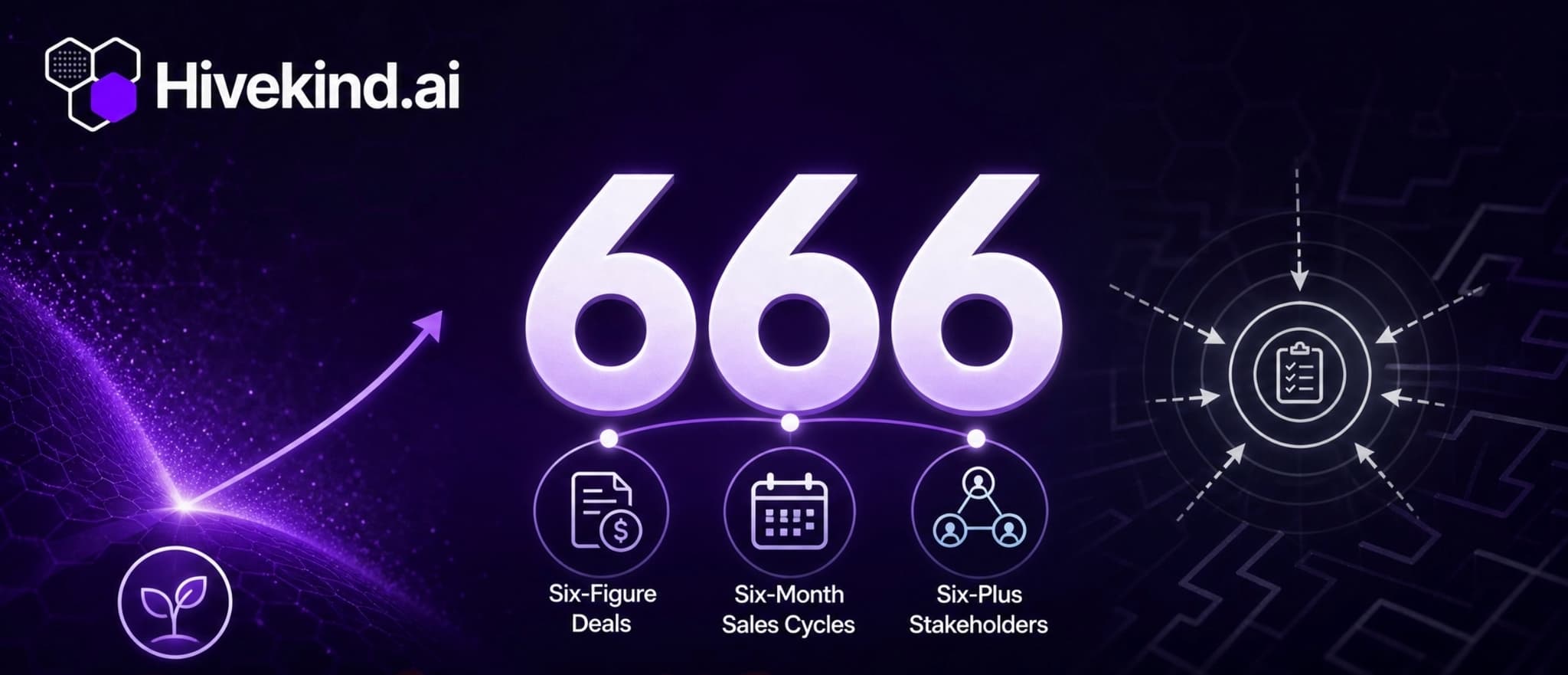
If your deal shape is six figures, six-month cycles, and six or more stakeholders, demand capture doesn't just underperform. It completely breaks. Here is why, one number at a time.

1. Six Figures: Demand Creation Is Budget Creation
At six figures, there is no loose budget sitting around waiting for your rep to show up.
At this price point, someone inside the target account has to actively build a business case. That means you aren't actually competing with direct vendors; you are competing with the null option and whatever other strategic initiative that money was originally slated to fund.
The Reality: Demand creation and budget creation are the exact same job. If you wait until they have an active budget, you've already lost control of the price tag.
2. Six-Month Cycles: The "Column Two" Trap
By the time an account shows up on your intent software, they are already 60 to 90 days into their internal evaluation process.
Someone else already helped them define the problem. Someone else wrote the requirements. Whoever created the demand in the first place wrote the evaluation criteria, and every other vendor who relies on capture is just bidding on their spec.
That isn't a close-rate problem. That's showing up as an option in Column Two.
3. Six-Plus Stakeholders: The Silence That Kills Deals
One lonely champion researching your software isn't a buying committee.
Intent data routinely surfaces the researcher, but it almost never surfaces the economic buyer or the CFO who quietly kills the deal in an executive session you weren't invited to.
And that brings us to the real failure mode in enterprise sales: most six-figure deals don't die to a competitor. They die of non-consensus. No official loss reason. No competitor chosen. Just total silence.

What Actually Changes When You Take This Seriously
If you accept the math of 6-6-6, your entire go-to-market motion has to shift:
- Stop qualifying on intent; qualify on situational context. Look for trigger events: a new exec hire, a funding event, a major reorg, or a compliance deadline. Those predict a problem forming two or three quarters out, which matches your cycle length perfectly.
- Stop measuring the lead; measure the account. Do not mark an account as "engaged" until you have meaningful touchpoints with at least three of the six core buyer roles.
- Build content your champion can repeat without you. At six-plus stakeholders, your point of view has to survive being retold by a non-salesperson in an internal meeting. If your pitch needs your slides to make sense, it will never move a committee.
- Stop watching MQLs; watch committee awareness. Pipeline is a lagging indicator. Account-level committee coverage is the leading indicator that actually predicts revenue.

The Bottom Line
At 6-6-6, demand capture doesn't create pipeline. It simply inherits pipeline that someone else created, on terms someone else already set.
That isn't a conversion problem, it's an origination problem. And nothing you do downstream is ever going to fix it.