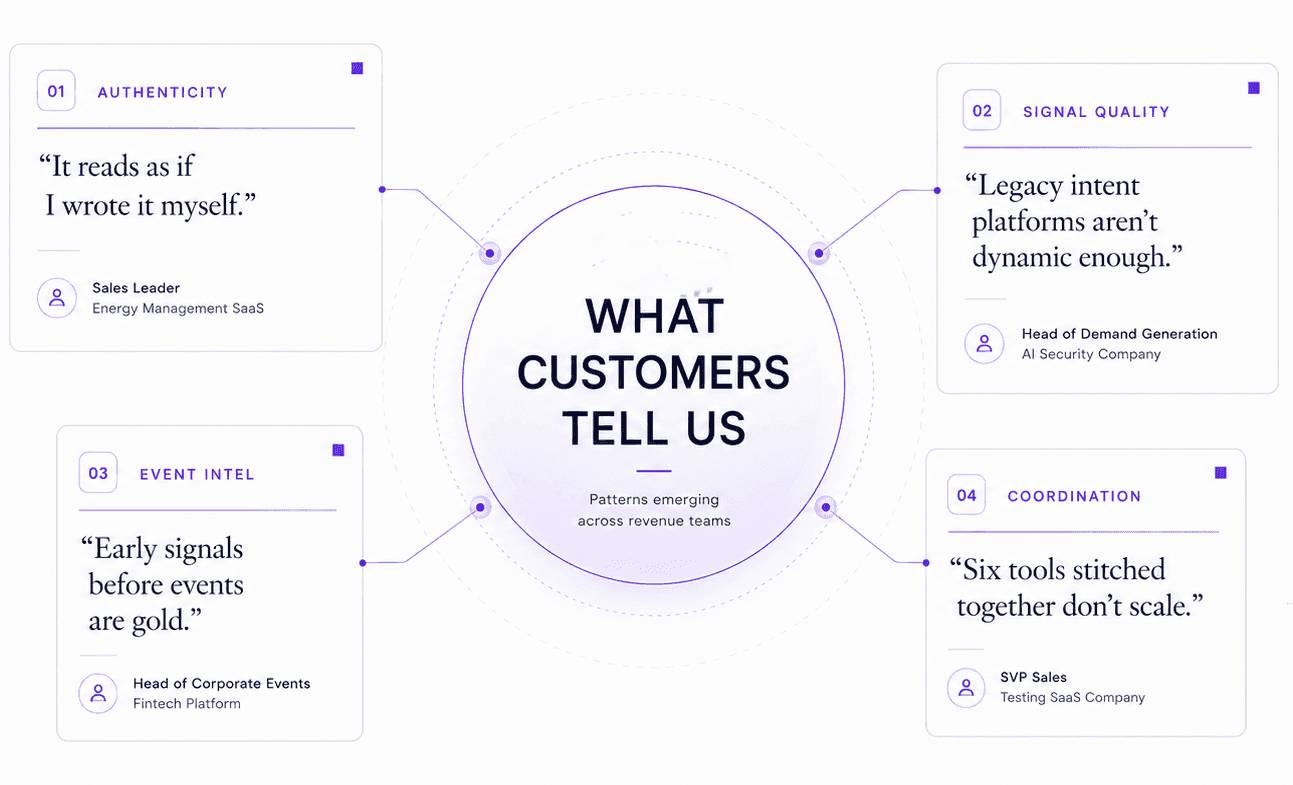
Over the past 6 months, we engaged with revenue teams across IT services, test automation software, energy management SaaS, fintech, AI security. Following are the patterns that surfaced, in the words of the people running these teams.
Pipeline is an outcome. The decisions that create it happen earlier - and for most revenue teams, those decisions are made by default rather than deliberately.
We've observed four patterns that point to something big, a shift in how go-to-market needs to work.
The best outreach doesn't feel generated
The promise of AI in go-to-market has largely been framed around speed: more emails, more content, faster. But the real bottleneck isn't volume. It's authenticity.
Every revenue leader has experienced opening an AI-generated email and immediately knowing it wasn't written by someone who understood the account, the buyer, or the business. The signal is subtle but instant, and it kills the conversation before it starts.
A sales leader at an energy management SaaS company running their North America business recently reviewed sequences generated through Hivekind and shared this: "When I review the emails, they read as if I wrote them myself. That level of personalization and authenticity was immediately apparent."
The reason is simple. Messaging, buyer motivations, competitive positioning, proof points, and account definitions are stored as reusable context. Instead of starting from a blank page, campaigns inherit the thinking that already exists inside the business. The result is outreach that sounds like the company behind it, because it is.
The patterns buyers have learned to ignore
Context-driven outreach doesn't just sound better - it earns attention in a way that templated outreach no longer can. For years, outbound success came from mastering a predictable formula: find the right contacts, present the value proposition, ask for a meeting. Buyers have seen that structure thousands of times. Even as the templates change, the underlying pattern remains the same, and buyers recognize it immediately.
SVP-Sales at a mid-market testing SaaS company described the difference: "Hivekind's messaging doesn't follow the patterns prospects are trained to ignore. It reads differently, creates a real pause, and actually gets people to read."
The implication is significant. Earning attention increasingly requires context: knowing what's actually happening at an account, what the buyer cares about right now, and why this moment matters. Teams that can make those decisions well will have a structural advantage over teams still optimizing templates.
Tool chains ≠ Systems
The natural response to fragmented execution has been accumulation of more tools. Intent platforms, data providers, sequencing platforms, AI assistants, CRM - each solves a narrow problem, but together creates a new one.
The SVP of Sales continued: "You can stitch together six tools to do this, but it's expensive and hard to scale. The goal is to make repeatable outbound success simple."
A Head of Demand Generation at an AI security company made the same point from a different angle: "Marketing teams are tired of legacy products like 6sense because it's not dynamic anymore. Hivekind is a stack consolidation plus automation play, and that's really required in today's landscape."
The underlying problem isn't access to information. Most teams already have more signals, more contacts, and more data than they can act on. The challenge is deciding what matters — which accounts deserve attention, which signals indicate a real buying window, which stakeholders should be engaged, and what message is right for each one's context. More tools don't solve that. A coordinated decision system does.
Pipeline starts before CRM
The most important thing we've learned from customers is that their challenges rarely begin inside CRM. By the time an opportunity appears in a pipeline report, dozens of decisions have already happened, someone identified a signal (or ignored it), prioritized an account (or picked one by intuition), chose the timing (or defaulted to Day 1 of a sequence), decided which stakeholders to engage (or reached out to whoever was easiest to find).
Teams are increasingly aware of this gap.
As the Head of Corporate Events at a fintech platform described it: "Our marketing and finance leaders say that if we had early signals to tell us who was worth targeting at the event, it would be helpful. Our CMO says let's find a way to 'know before you go' who will be at the event."
That instinct ‘know before you go’, tells us that the decisions that shape pipeline quality happen upstream of CRM, upstream of execution, and upstream of the first email sent. Execution has become easy - AI generates emails, enriches contacts, and automates workflows. What remains scarce is judgment: knowing where attention should be focused, and why.
The shift we're building toward
These observations from different customers give us the same underlying insight: go-to-market is a decision problem, not an execution problem.
The teams that figure this out first will consistently know where to focus, who to engage, and why - all before a single campaign runs, before a single email is sent, before an opportunity ever reaches CRM.
We call this the Pre-Pipeline Layer. It's the system of decisions that determines where pipeline comes from. And based on what we're hearing from the teams closest to this problem, building that layer deliberately, rather than by default; may be the most important GTM advantage available right now.