AI SDR tools have gained enormous attention over the past year.
The promise is compelling: automate outbound, scale engagement, and generate pipeline without adding headcount.
Many teams experimenting with AI SDR platforms find value in what these systems do well: automating multi-step outreach, coordinating email and LinkedIn touches, updating CRM records, and running large campaigns at scale. Execution becomes dramatically easier, but the question is whether it also improves pipeline quality. The answer has been: not consistently.
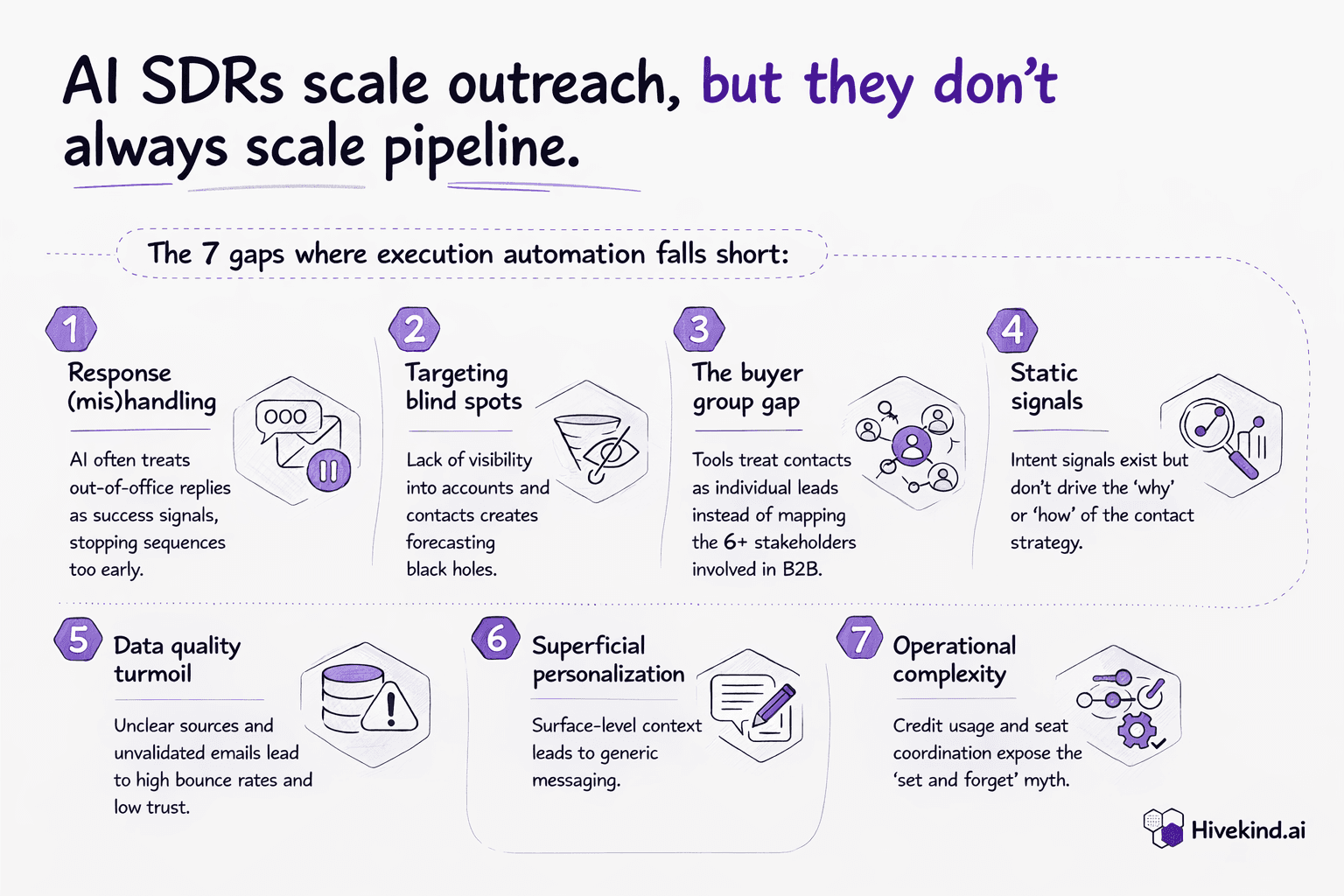
In a recent evaluation of a leading AI-driven outbound platform, we identified seven gaps that illustrate where execution automation alone can fall short.
We’ll also discuss what this means for the "pre-pipeline layer" - the upstream decisions that shape pipeline quality before execution begins.
1. Mishandling response types: OOO treated as a signal
Many automation systems treat any response as a success signal and halt the sequence. In practice, responses vary widely, for example, outreach sequences may stop automatically even if the response is an out-of-office message. Without context about the type of response, automation misinterprets signals and prematurely halts engagement.
This can lead to missed opportunities, and for RevOps leaders managing outbound programs, this creates a different problem: figuring out which paused sequences represent real engagement, and which just hit an OOO?
2. Lack of visibility into target accounts and contacts
AI SDR tools often begin with a simple instruction: “Define your ICP.”
Users describe their ICP in natural language and then get a preview of available contacts (say 5k) that match those criteria. The complete list is not made available, and neither is their source clear. Questions teams naturally want to answer remain unclear:
- Are my top accounts covered in this?
- Are the right contacts found?
Without transparency, you're left guessing whether you're working the right accounts or just the first ones that matched basic criteria. For sales leaders, that distinction messes up forecasts - when the accounts that "should" convert don't.
3. The buyer group gap: Contacts are pursued individually
Most B2B purchases involve 6-10 stakeholders. Yet many automated outbound tools still treat contacts as independent leads — reaching the champion at Account X without knowing the CFO, CTO, and procurement contacts will also have a say.
Each identified contact may receive outreach separately, without a clear view of:
- who else participates in the buying decision
- whether key roles are missing
- how engagement across the account evolves
This creates fragmented conversations rather than coordinated account engagement.
4. Signals exist but not always actionable
Many platforms incorporate market or intent signals. In theory, these signals should automatically influence when outreach occurs and what gets said. In practice, signals often exist in the platform but don't visibly connect to what the system decides to do next. There's no clear answer to: "why is this account being contacted today, and not that one?" Timing becomes arbitrary, and arbitrary timing is just another form of spray and pray.
Signals have limited value if not tightly integrated into prioritization decisions, message crafting and outreach timing.
5. Data quality and transparency matters
Outbound execution depends heavily on data quality. During evaluation, teams naturally want clarity on which data providers are being used, how contact information is validated, and whether emails are verified before sending. When that transparency isn't available, or only a sample of enriched data is available for examination (as was the case here), confidence in the system drops.
Unvalidated contact data also leads to higher bounce rates that negatively impact domain authority and reduce campaign effectiveness.
For compliance-sensitive teams in regulated industries, not knowing your data provenance is a blocker.
6. The personalization reality
AI-generated emails are improving rapidly. But in many cases, automated messages still rely on surface-level personalization.
Teams evaluating these tools often end up refining the messaging themselves, or even revert to segment-specific or use case based emails created by their PMM team.
That's a structural limitation: personalization is only as good as the context fed into it. Without upstream account research and buyer-group intelligence, you're forced to use the email templates you had. Which is essentially what teams were doing before — just with more steps!
7. Operational complexity still exists
Even highly automated systems introduce operational considerations.
Credit usage model for contacts and LinkedIn connections, especially when used by multiple reps and SDRs results in tracking nightmare, exhausting credits fast. Additionally, limits on LinkedIn outreach per seat, and coordination challenges across multiple reps add to operational chaos.
Individually, these aren't dealbreakers but collectively, they add up to more hands-on management than 'set it and forget it' positioning suggests.
The big insight
None of these observations invalidate the value of AI SDR tools - scaling execution is welcome.
But experienced GTM and revenue leaders know that pipeline quality is often determined before execution begins.
Questions such as:
- Which accounts should we focus on now?
- Which stakeholders matter in this account?
- What signals indicate the right moment to engage?
- How should messaging across the buying group be coordinated?
These decisions shape pipeline outcomes long before the first email is sent.
The Pre-Pipeline layer
We refer to the upstream decision layer as pre-pipeline. Pre-pipeline systems focus on questions like:
- Continuous ICP prioritization
- Account research and pain point identification
- Contact enrichment, validation and full transparency before execution
- Buyer-group mapping across accounts
- Message generation referencing the brand positioning
- Coordinated outreach across stakeholders
- Right next step for each response type - OOO, unsubscribe, interest, question
- Decision transparency for GTM teams
Execution automation works best when these decisions are clear, so one is not scaling the wrong effort. They're the daily decisions RevOps and sales leaders make (or struggle to make) if execution tools lack upstream intelligence.
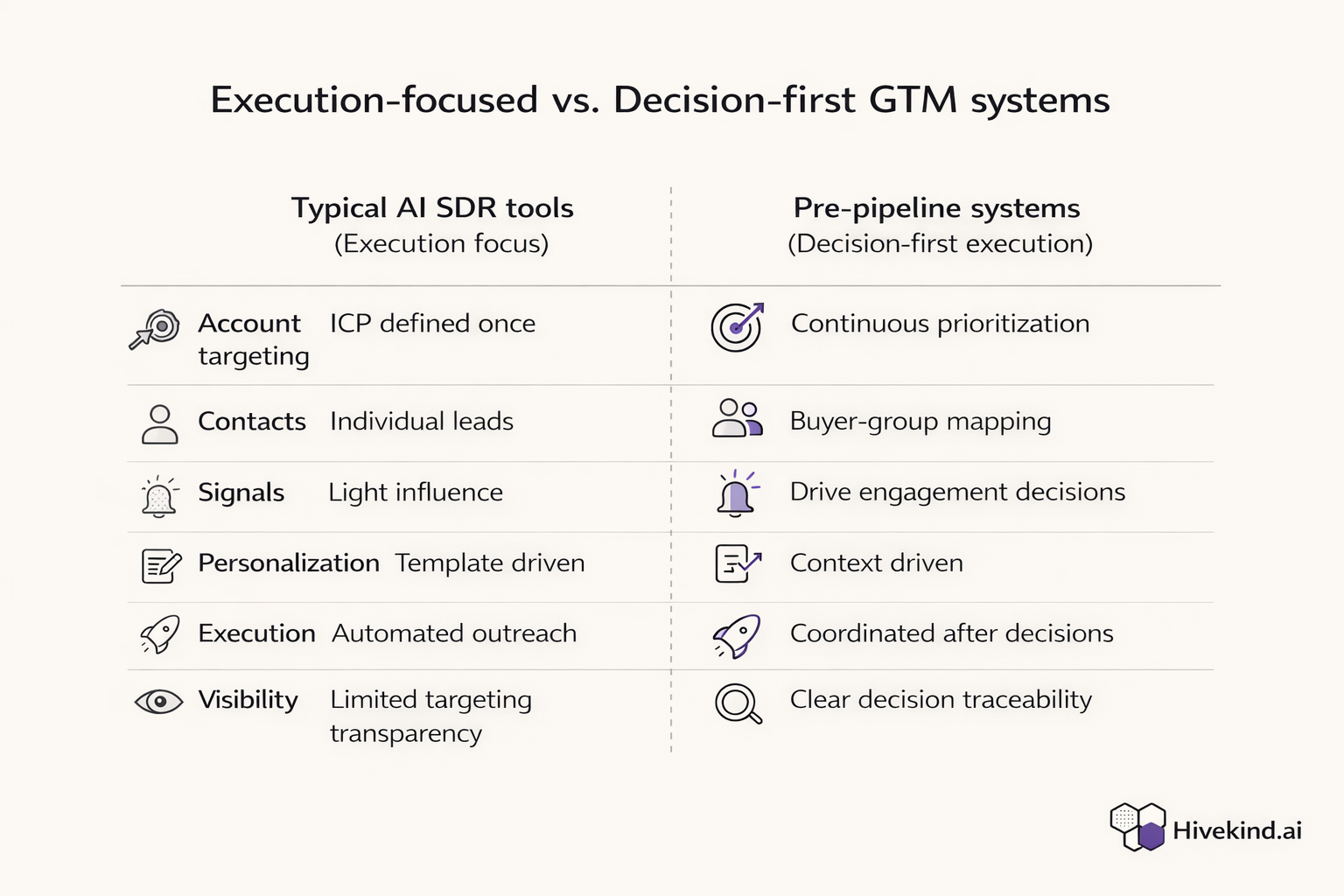
Pipeline is rarely created by execution alone
Automated outreach is a powerful capability. But pipeline quality reflects the clarity of decisions made before execution begins.
As AI SDR tools continue to evolve, the systems that connect execution with upstream GTM decisions will likely define the next stage of the category.
Because pipeline is rarely created by activity alone. It's shaped by the decisions made before that activity begins.
What this means for Revenue Leaders
If you're evaluating AI SDR tools, ask these questions:
- Can I see how accounts are prioritized, or just that they match ICP?
- Does the system map buying groups, or treat each contact independently?
- How are signals actually used - are they part of the decision input?
- What happens when someone replies with an OOO or polite decline?
- Can I audit which data sources are being used?
The answers reveal whether you're buying execution automation (valuable) or execution + decision intelligence (transformative).
Key Takeaways
- AI SDR tools excel at automating outreach execution.
- Pipeline quality often depends on decisions made before outreach begins.
- Many outbound systems treat contacts individually instead of mapping buyer groups.
- Signals and targeting data are often present but not deeply integrated into prioritization.
- Pre-pipeline systems focus on account prioritization, buyer group mapping, and signal-driven engagement.
FAQs
1. What is an AI SDR?
An AI SDR is a system that automates outbound sales activities such as prospecting, messaging, follow-ups, and CRM updates using AI models and automation workflows.
2. Why isn’t my AI SDR tools generating consistent pipeline?
AI SDR tools automate outreach execution, but pipeline quality is often determined earlier by decisions such as account prioritization, buyer-group identification, and engagement timing.
3. What is the difference between AI SDR tools and pre-pipeline systems?
AI SDR tools focus on automating outreach.
Pre-pipeline systems focus on the upstream decisions that determine who should be engaged, when outreach should happen, and how buyer groups are coordinated.
4. Should I use an AI SDR tool?
AI SDR tools excel at scaling outbound execution. They're valuable when you have clear targeting decisions, defined buyer groups, and strong data quality. They're less effective when used in absence of upstream GTM strategy—account prioritization, buyer group mapping, and signal interpretation still require dedicated systems or manual work.
5. What's the difference between AI SDRs and sales engagement platforms?
AI SDRs automate prospect research, message generation, and multi-channel outreach using AI. Traditional sales engagement platforms (like Outreach, Salesloft) execute sequences you build manually. Both focus on execution. Neither typically handles upstream decisions like account prioritization or buyer group mapping—that's the pre-pipeline layer.
6. What is pre-pipeline?
Pre-pipeline refers to the set of decisions that shape pipeline before outreach begins.
These include:
- Which accounts should be prioritized
- Which stakeholders form the buyer group
- Which signals indicate buying readiness
- How outreach across the account should be coordinated
AI SDR tools primarily automate execution. Pre-pipeline systems focus on the decisions that guide that execution.