
If you’re a marketing leader in B2B SaaS, you’ve almost certainly heard of ABM platforms like 6sense, Demandbase, Terminus and many more. They promise account-based targeting, intent signals, and orchestrated campaigns. For more than a decade, account-based marketing (ABM) has helped B2B companies focus their efforts. It replaced the spray-and-pray approach with precision - find the right accounts, watch their intent signals, and reach out at the right time.
Yet many CMOs today admit that while precision has improved, it hasn’t necessarily translated to predictable growth. Campaigns still rely on armchair marketers and their hunches. Conversion rates are uneven. And intent signals haven’t provided the confidence they had promised.
Why Intent Signals Are Losing Their Edge
It’s not to say that ABM has failed. It worked when data was scarce and intent patterns were simple. That’s not the case anymore. Sure there’s value in that part of the puzzle: buying signals, anonymous web visits, display reach. But now, every company is producing signals - hiring, expanding, researching, fundraising, investing. These signals have become so noisy that they are unreliable. Intent data can tell you who might be interested, but not why, or what to do about it. GTM teams are often left with more information than they can handle.
Imagine you sell a CRM platform, and a large company reads an article about “CRM integrations for high-growth SaaS” on a publisher site. Intent data flags that company as showing “interest.” Your campaign triggers. But chances are that intent was too loose, more out of curiosity - without any real need, no budget, and no stakeholder buy-in.
Third-party cookies and broad “intent” data was supposed to help you spot buyers early. Platforms like Bombora built their business around tracking content consumption, keywords, and web behavior. But the tracking world has shifted and is under scrutiny. Apple’s App Tracking Transparency (ATT) policies, Safari browser’s Intelligent Tracking Prevention (ITP), and Google Chrome pausing on the full phase-out of third party cookies, have all risked the signals available to intent vendors.
Bombora notes that many of the data-collection methods rely on publisher networks and bidstreams and keywords (rather than actual meaning), and these are under pressure from data privacy and regulation changes.
At the same time, the internal piece and first-party data (deal outcomes, CRM insights, deal champion, tech stack nuances) isn’t built into the system.
This gap can be addressed by combining internal first-party data: what deals were won and why, customer interactions with external signals (like filings, earnings calls, key events) that are verified and contextual. Insights become reliable when the system behind it is trusted, and together, these build a more complete picture of demand, one that actually learns and improves over time. Another dimension is better ICP definition, not just the vertical/ company size, but dynamic refinement based on recent wins and losses.
So it’s not just about tracking intent, but also understanding context that creates a winning recipe for growth organizations.
Comparison: ABM Tools vs. Hivekind
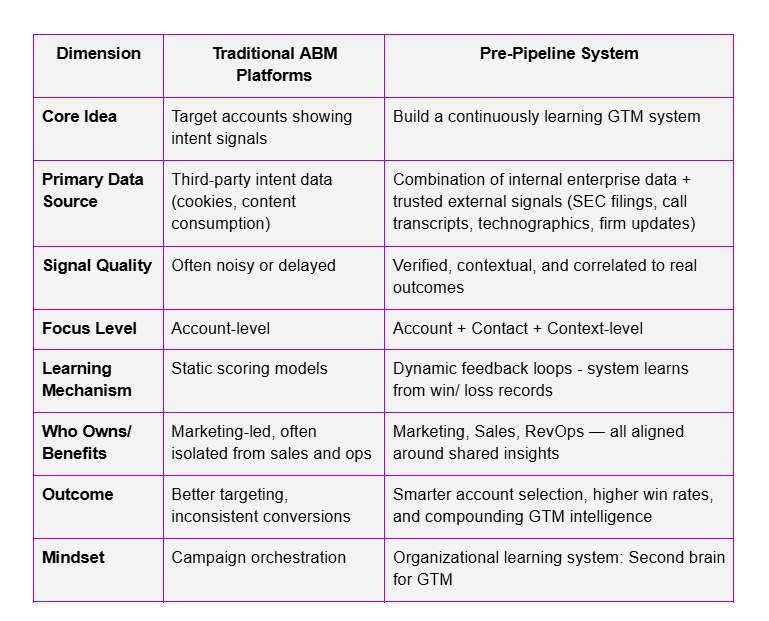
Why This Matters
Teams are spending more time coordinating than selling or innovating. If signals lack context, every outreach feels bland. Larger organizations face delays implementing “next-gen” tools because change requires many stakeholders buy-in and trust that it works.
A system that begins with internal data and then layers external signals helps build confidence in what the system is recommending. Repeatable growth comes from each interaction teaching the next one.
The Alternative
What the most forward-thinking GTM teams are doing now is building systems that learn with them, not just work for them.
These systems:
- Use enterprise-level signals and enrichments at account and contact level.
- Connect internal outcomes with external behaviors to sharpen ICPs and messaging.
- Make feedback loops central — every win, loss, and interaction refines the next play.
- Enable cross-functional alignment — marketing, SDR, AE, and ops are no longer separate engines but parts of a unified system.
Over time, the system improves. It becomes an asset that compounds, like a high-performance team that gets sharper every quarter.